Inside the process of how story and math change our world

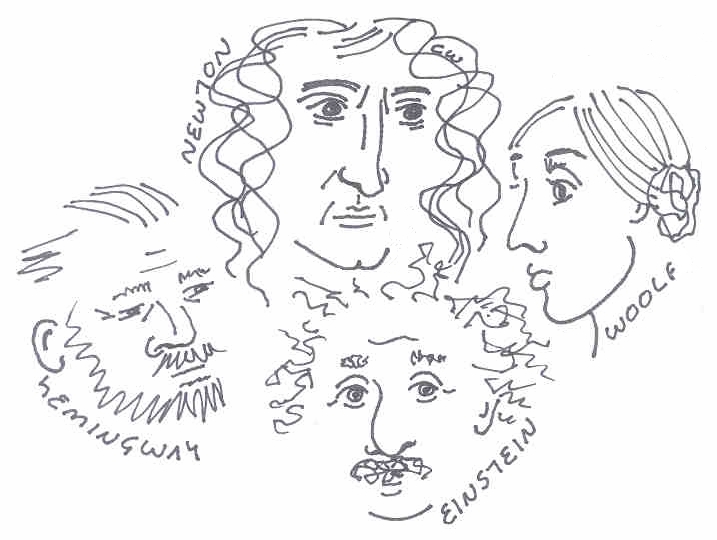
historical geniusesHeisenberg’s uncertainty principle applies equally to particles, parabolas, and prose. To describe – which is the common goal of any story or mathematical formula – is to influence the object of observation. Our reflection of reality becomes our measure of the world. isaac newton caricatureBut while Heisenberg’s electrons were thrown off course by photons, the change in our reality is essentially rooted in perception. And because perception is our brain’s only way of interacting with the universe, a change in perception equals a change in our world.

Truth is variable according to our experiences. Our experience of ideas, concepts, and proofs come together to pattern our perception of the truth of our reality. ernest hemingway caricatureWhen not individualized through direct sensory exposure, this ‘experience’ is communicated to our neural networks through a language of symbol: story through words, math through numbers. Both math and literature humanize a universe fraught with chaos by translating it into patterns of information compatible with the structure and function of our brains.

The only difference between story and math is the path of emotional access. Both words and numbers are symbols loaded with meaning and expectation of pattern of connection (eg. sentence structure/ B.E.D.M.A.S.). albert einstein caricatureHowever, words have broader associations and are linked with emotions that, when activated, open and extend our logic parameters to create new suspended realities. We can choose to incorporate these new worlds into our own (The Globe and Mail, religion, this post) or simple abandon them when we get to the last page (fiction, Calgary Sun). Mathematical symbols have a much stricter pattern of expectation that, upon entering the brain, must first be vetted by the logic system in our prefrontal cortex before giving us an emotional response/release in the form of soothing contentment (eg. simple beauty of E=mc2), or that sick feeling you get in your stomach when a formula turns out to be bullshit (eg. string theory… don’t get me started!).

virginia woolf caricatureInterchangeable except for path of emotional access, every story and mathematical formula use a shared humanized language of symbol to communicate novel patterns of perception that, if adopted as truth, change our world.

Under the muumuu – A woman and her addictions exposed

walmart muumuu

“I’m lost.”

If these words are yours, own them. Wear them. Go to Walmart and buy the widest, ugliest muumuu you can find. Take it home and drape it over your naked body. Be brave. Look in the mirror and see your true reflection. This is reality. This is what your brain has done to your life. There is no shame here, only pattern and practice. This is habit, addiction, and insatiable desire…

“I’m so sorry,” says the woman trying to squeeze herself through the doorway of my Blank Canvas Living Creative Counselling office. She’s wearing what’s got to be the most horrifically unflattering muumuu ever created.

“Don’t apologize,” I tell her. “The only thing you have to be sorry for is, quite frankly, that awful muumuu. Why on earth would you do that to yourself?”

“I’m lost,” she says, and bursts into tears. She’s in the room now, but she can’t even sit down. There’s some unspeakable bulk, all sharp corners and clinking sounds, writhing under the synthetic pink and orange atrocity.

“You’re here now, and that’s huge. Not as big as that muumuu, mind you, but major non the less.”

She gives a weak smile at my even weaker joke and looks at me expectantly. This is how it always goes. There’s this idea that I’m going to make some diagnosis and write a prescription or trace some emotion back to its pattern of childhood origin. But that’s not the way creative counselling works. I’m not here to waste anybody’s time. My job is to strip the problem down to the story and brain habits that are causing it. And I know this woman’s not going to like what I’ve got to ask her to do.

“Take it off. For the love of gawd,” I beg her, “take off that hellish thing so we can see what we’re dealing with.”

“What?” She says, giving me a worried look. “Seriously? But I’m not wearing anything underneath.”

“Good, all the better. Don’t worry, I’m not trying to be perverted or anything. Just trust me on this.”

She fusses and fidgets, delays, protests, and delays some more, but I won’t let her off the hook. Finally, with infinite reluctance, she takes off the muumuu and drops it on the carpet between us.addiction woman illustration

Bottles of white wine, cases of diet coke, cigarettes, tabloid magazines, 12 boxes of Peek Frean cookies, television remotes, Facebook screens, automatic negative thoughts, phones waiting for calls from bad men… the baggage is a tonnage of habit and addiction. The woman’s body is creamy and lovely at the center of it all, but her face is red with shame. She won’t even look at me.

“I’m so sorry,” she whispers, “I never realized how bad things are, how much I’ve been carrying around. It’s ugly isn’t it?”

“Not near as ugly as covering it up with that gawd awful muumuu like you’ve given up on yourself. Look, if you’re brave enough to show me your body and brain like this, then you’re brave enough to change it. You don’t need all this shit. I can give you a new language and way of maximizing your humanity without needing to rely on external emotional regulation. I’m not talking about yoga rituals or 12 steps. I’m talking about a way of real-time dialoguing with your brain’s perception of reality. You just leave that muumuu with me and I’ll transform it into a tactile demonstration of what this process is all about. Sound like a plan?”

“This isn’t some new-age-y bullshit, is it?” She asks. I can’t blame her; I’d be suspicious too.

“No bullshit. It’s already saved lives, including mine.” I leave her curious as I go to find her another outfit to wear home.

This is a Story Thread post – Click to read more…

How to use brain priming to improve your productivity and quality of life

spring cleaningThis simple 3 step formula will allow you to design life strategies based on your own unique neural network of associations and experiences. Brain priming, where “exposure to a stimulus influences a response to a later stimulus”, is essentially the firing of neurons that are linked in your brain. This happens automatically and below the level of conscious thought. For example, student subjects primed with words related to the elderly left the experiment walking slower than the control group.

But we can make brain priming an active, rather than just a passive, process. Self-priming before an activity and extending that stimulus throughout its duration can help us tackle difficult tasks with more energy and improved perspective by taking advantage of the brain’s existing network of linkages. And what task could be more difficult, more intimidating, more soul destroying, more ‘oh-gawd-why-me’ agonizing than… cleaning the house.

Brain Network MapStep 1: Identify the activity and hypothesis your initial linkages (concepts, associations, emotions). Try to be as honest and intuitive as you can. You can use the diagram above as a model. It shows a simplified network of what, in reality, is quite a messy bit of between-the-ears business. But I’m a sucker for symmetry, both in my men and in my visual aids.

Step 2: Identify the positive (encouraging links are in blue) and negative (paralyzing links are in red) connections/associations. The positive links are your Gateway Connections.

Step 3: Identify sensory and memory recall experiences that will stimulate these same positive attitude/energy bundles of neurons. Here’s where it gets fun! Get psyched to try a tough new recipe by Youtubing with some Anthony Bourdain… Wear a tie and watch ‘Report on Business’ TV before an economics exam… Give your partner a massage before asking them to do the dishes (maybe I should have tried that one)… Go ahead and get creative! Engage your network strategy and keep those areas lit for as long, and as intensely, as possible. In this example, cute underwear (just don’t ask about the ‘in control’) and Janis Joplin’s rockin’ blues link to my three positives about cleaning. Cleaning the bathroom Note: ‘setting the stage’ has an extra semantic bonus with Joplin. Joplin and panties also have their own web of interconnecting linkages (shown in green) to directly counteract the original red negatives, thereby overriding them.

And because any scientific strategy is best served with a completely gratuitous selfie, I offer you hard-core proof that this brain priming formula will make even the most intimidating task suddenly… dare I say… far more enticing.

So hard to pick a toothpaste when all patterns end in sex or death

trauma in the toothpaste aisle

We process the world through pattern. Our brains filter the sensory madness of our culture through ever narrowing channels of meaning and importance. But let’s be honest, whatever your program of associations, all patterns end in either sex or death. Sex extends our genetics through time and is the only motivator on par with avoidance of death – the eventual, inevitable endgame to all sequences of decisions.

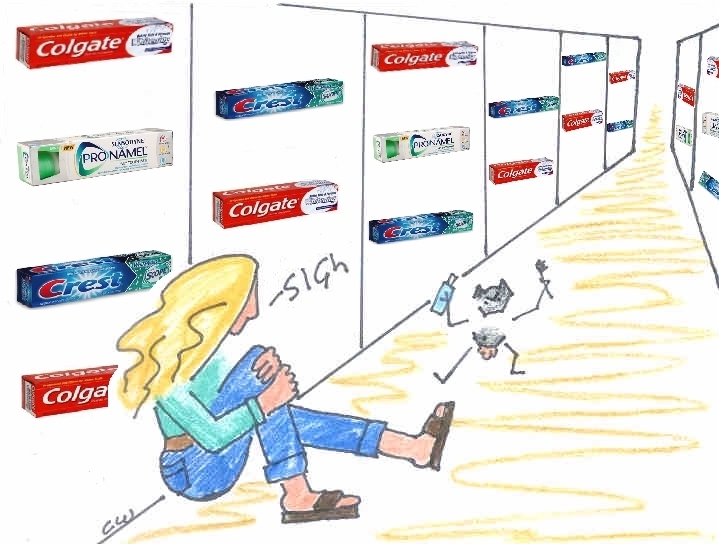
I’m paralyzed in the toothpaste aisle. I feel my temperature rising, my palms getting sweaty. Why the hell does my amygdala have to get involved! It’s just f*&^king toothpaste! The eternal struggle: buy my ‘usual’ and save myself some cognitive calories, or engage in a complex multi-variable algorithm steeped in conflict between conscious and unconscious influences and motivations. Do I want short term gains like fresh breath and whitening? Both driven by the ever tempting promise of getting laid. Or do I go for long term investment with tartar control, enamel repair, and preventing gingivitis (the villain in so many bacteria-in-the-bloodstream early death horror stories!)? Then there are the ‘do it all have it all’ formulas, the ‘full-time working mothers’ of oral hygiene. But like Sheryl Sandberg, I’m suspicious there’s some unspoken compromise that just might result in a root canal somewhere down the line. I grew up using Colgate… its red is so soothingly familiar… but ProNamel’s packaging looks so reassuringly clinical… and Aquafresh has… Oh for heavens sake!!

Pavlov’s dogs were trained to salivate at the ringing of a bell, but his subjects would often begin to drool far earlier in the experimental sequence: approaching the experimental apparatus, when lab assistants entered the room, etc. Our own programming wakes with us in the morning and maps the day into expectations and associations. Our circuitry can be as rigid as rail lines, and neuroplasticity involves the same taxing bureaucratic nightmare of time, energy, and ego as engineering Calgary’s West LRT line. Change is hell. With sex or death being their axiomed ends, we must confront our patterns at their beginnings, especially ones as powerful as those involving ‘the paradox of choice’.

I should have visualized a game plan and anticipated my distress. It’s too late by the time I’m standing here feeling like an idiot for being so overwhelmed by freakin’ toothpaste! At this point, metacognition is my only hope. I calm my breathing and my head begins to clear. My prefrontal cortex takes charge. “What’s the worst case scenario,” I ask myself. It’s just toothpaste! And four magic words follow the analysis: “I can handle it.” I engage a new pattern and apply the retail version of my good-girl-bad-girl personal philosophy, and come home with two tubes – ProNamel and Aquafresh – and ‘spit’ my time between. What can I say? I’m now a proud personal hygiene polygamist (but hopefully not “till death do us part”)!

New hunter/gatherer theory on why men love watching playoff sports

jonathan quick la kings
Kopitar’s got the puck, passes to Carter for a sweet little one-timer – Elliott never had a chance – Kings score!!

The man beside me explodes off the couch with a terrifying “YAAAAAAA” Viking battle cry of testosterone madness that shoots me straight into an adrenaline panic. Fight – give him hell for freaking me out? Or flight – escape to the kitchen and (relative) safety of doing the dishes? Or try a new game this playoff season and turn this moment into an impromptu anthropological study…

Note: I love sports… PLAYING THEM! Don’t let my blonde ponytail and figure skates fool you, I’m competitive as hell and I’ll battle you into the boards until I get the puck or until one – or both of us – is bleeding. But men seem to get the same high from just watching tiny figures frolicking around on a screen. Ya, I know there are some women who get off on it too, just like there are some women with gigantic natural tits who authentically enjoy the taste of beer, but those genetic hybrid freaks should stop reading this and go out and mate with the head honcho at the local pub and leave the rest of us to our jolly gender generalizing.

Ok, so for men to get so passionate about playoff sports, two things must be happening in the brain:
1) Ongoing sensory engagement
2) Ongoing emotional involvement

hockey brain notesI get out my notebook (once a nerd always a nerd…sigh, and to take a picture of said nerdiness is, I suppose, taking it to a whole new, almost scary, level) and ask my male specimen some very scientific questions about his hockey viewing experience – on the commercials of course! In contrast to my own ever shifting tunnel vision, he describes being able process the entire screen’s on-ice action as a whole, while keeping track of who’s who and what they might do in present/upcoming plays. He also has the rules and play history on automatic recall. Hmmm.
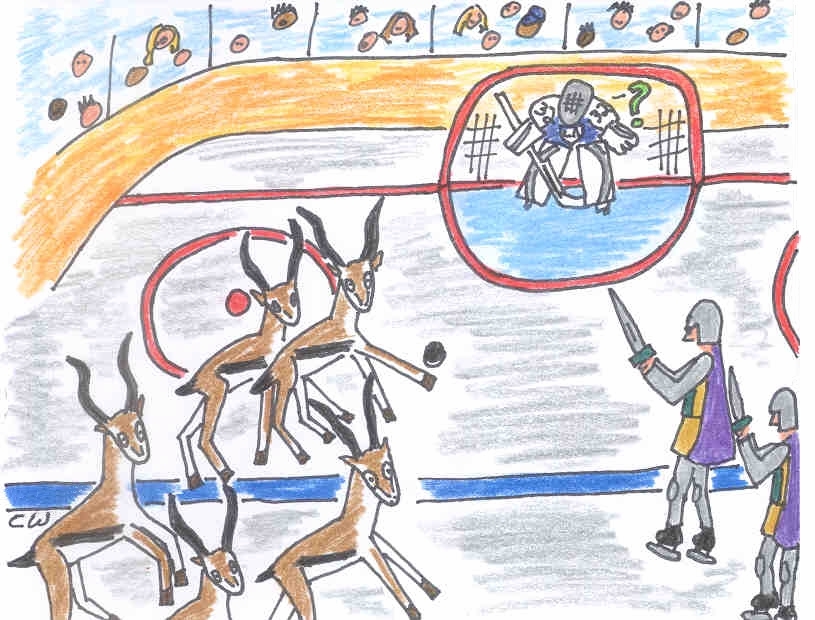
watching sportsIt’s generally accepted (because what’s any theory without some good healthy generalizing) that for hundreds of thousands of years humans lived in small groups, with men mostly chiefing, warring, and hunting for meat, while the women gathered edible vegetation, reared the children, and maintained the social structure of the tribe. Starting with this evolutionary background, let’s identify the commonalities across three similar planes of ‘man reference’ that could produce the two brain prerequisites noted above and account for our test subject’s (ok, my test subject because I’m sure not sharing him, not even for science!) qualitative viewing experience: the plains of Africa, a medieval battlefield, and the LA Kings slaughtering the St. Louis Blues in game five…

Man reference plane commonalities:
1) Ability to track herd/army/team as an entirety while picking out weak links and anticipating individual/group behaviours
2) Sustained sensory/emotional involvement to maintain motivation towards final kill/win/goal
3) Death (or death of team’s season by elimination) must be risked for brain to warrant such high caliber emotional/attentional involvement/payoff
4) Strong allegiance to specific tribe/king/team through shared history and/or ancestry – loyalty engages emotion and motivates risk taking
5) Auto recall memory for history of success and specific rules of the hunt/battlefield/game help ensure repeat kill/victory/win
6) Short term goals (emotionally and physically) important to overall victory: multiple spearings lead to enough prey to feed tribe, multiple skirmishes/battles lead to overall war victory, multiple goals lead to ‘best out of 7’ and next playoff round

Reality TV face-offThus, the mystery is solved. Men love watching the playoffs because they are men, evolutionarily speaking. We can now apply a similar formula to explain to my horrified man specimen, why, as a woman, I’m helplessly unable to change the channel whenever I ‘accidentally’ click myself into The Real Housewives of Vancouver.

How to survive a woman who threatens your universe at the atomic level

universal photocopier“I’m pissed off.” The red haired woman states the obvious, with equally obvious venom.

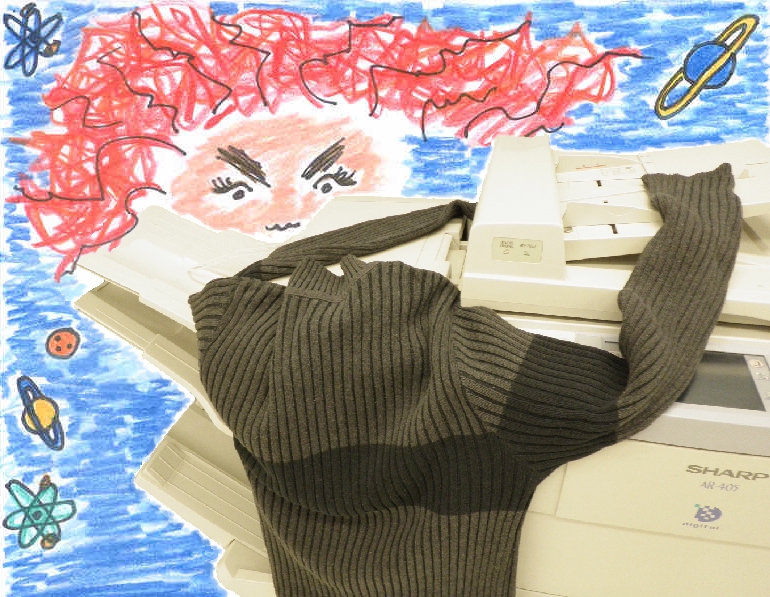
I think I hate her. The realization is sudden, visceral, and acute. My stomach has made up its mind. She presents as an archetype I’ve spent my life avoiding eye contact with in high school hallways and grim office elevators. Not that I can’t come around – I’ve done it before – but the photocopier she did battle with earlier has my sympathies. And now that I’ve sacrificed the sleeves of my sweater to her jury-rigged straightjacket, there’s no turning back.

“I can see that,” I say. “Three minutes, will you give me just three minutes?”

“You’ve got a captive audience, girl.”

Swallowing her ‘girl’ with quiet martyrdom, I take her ever so gently through a 3 Minute Sense Scroll Mindfulness Meditation – my go to innovation that has helped my own brain rewire to focus its attentions, engage with the environment, and emerge from internal constructs/conflicts.

“There.” I breath deeply, feeling quite relaxed myself. My perception of my client is momentarily softened and compassion is awakened by my reconnection to self. “Are you feeling a little more grounded now?”

“No.”

The word is spit with a certain – yes I’m certain – gleeful malice that hits me right in the gut. How could any brain resist such a powerful tool? Must be out of spite. But why would any mind fight its natural craving for balance and peace? Her death stare is unrelenting, and now she’s fidgeting in her straightjacket and stretching my sleeves more and more by the second. I’m appalled by her total disregard for another person’s property. The photocopier becomes personified in my mind, poor thing. I empathize with its jamming now that the gears in my own head are locking up. And here she is traumatizing something else that doesn’t belong to her. Bitch.

“Shit.” I say. To which she looks triumphant. Drawing a blank in the face of such hostility, I reluctantly serve the cat her cream: “So why don’t you just tell me what’s pissing you off.”

I see her mouth open as she sucks in not only all the air in the office, but all available energy too, extending her vacuum to rob our oxygen atoms of their very spin as they’re drawn into her black void of negativity. I swear my eyeballs bulge and the overhead florescents flicker and dim as their photons are stretched and dragged screaming, tearing, into the abyss. Only a black hole or an angry woman can disrupt the space-time continuum – I know this, just ask my husband. But I could never match this wild haired force of nature. Sleeve assault aside, this woman’s utter disregard for the room’s atomic balance leaves nothing even remotely sustaining for me. Bitch.

“Wait!” I cry out, all hard-won professionalism abandoned. “I have a better idea.”

This is a Story Thread post – Click to read more…

Secret to how to REALLY start doing things differently

I once witnessed a car accident while driving with my sister-in-law. At impact, the red minivan two cars ahead of us lifted up and spiraled like a football into the ditch. Mercifully, there were only minor injuries. After attending with water (and chocolate) until the paramedics arrived, we were asked to write witness statements. Upon reading each other’s, my sister-in-law and I were surprised to find that what we’d paid attention to was wildly different. Our attentions can be inherent to our coded personalities, cultural, or based on personal experience. But here’s the secret: retraining your attentions will give you incredible freedom of action.

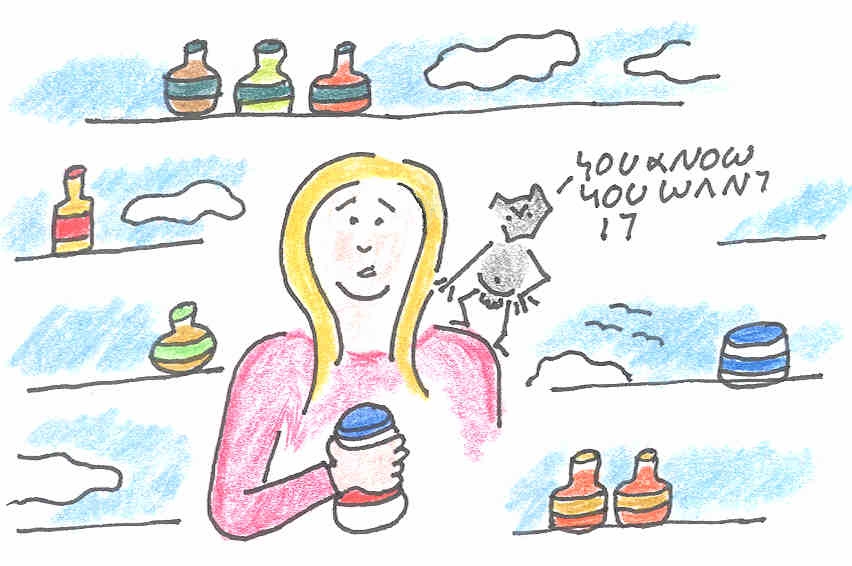
Now let’s go to the grocery store. If you noted and evaluated every single one of the tens of thousands of products sold at your average grocery store… well, quite simply, your brain would shut down. In reality, we each walk into a markedly different store, depending on our tastes and habits. Like those big green signs on the highway, our attentions allow the rest of the landscape to blur into the background. A few weeks ago, I was standing in the salad dressing aisle with a bottle of Miracle Whip in my hand – not only Easy Squeeze, but on sale too! See that fellow on my shoulder in the illustration above? That’s Mitch – my insatiable human itch. When you give something an identity (Mitch’s origins will be explained in an upcoming post), you give yourself the freedom to open a dialogue. NOTE: This isn’t any sort of talking-to-yourself or actually seeing the little guy weirdness, just a fun philosophical allegory, like Nietzsche’s Zarathustra or Virgil’s guides in Dante’s Inferno (although I don’t suppose either of those two examples could be called particularly ‘fun’).

When you can dialogue with your primal human drives, habits, and interpretations (dare I say subconscious), you can begin to challenge your reflexive attentions, thoughts, and actions. In this case, choice of salad dressing. Don’t let a touch of natural, biological anxiety hold you back from trying something new. Our neurotransmitters are calibrated to keep our patterns stable in this so often unstable world… just push through (practice makes it easier). I’ve always thought about trying to make my own dressing, so told Mitch to shove off, and through the subsequent catecholamine haze, went hunting for apple cider vinegar, canola oil, and a good novelty mustard.

This shift in attentions began to change my experience of the store. New products came into focus, new flavour combinations, textures, and possibilities for combination. I was essentially shopping a different store, not literally, but a new menu for selection had opened up on familiar shelves. In lieu of an allegory brush off, you can also try this…

Practical Exercise For Retraining Attentions: Next time you’re in the grocery store, arbitrarily pick a 2′ by 2′ area of shelving. For every product within that square, imagine being served a sample at a dinner party. How does it taste? Smell? Look? What is it being served with? What are people talking about while eating? Build a story around it. Then pick one of these products (one you’ve never picked before) and have the balls, yes I said it, balls, to put it in your cart. You can stop here, or if you’ve really got kahoonas, build a dish around this product and see how your story plays out when you serve it to your family.

How to survive life as an artist – Inspired by the ages and stages of Robin Gibb

Robin Gibb, 1/3 of the legendary Bee Gees, cheated on his first wife with (by his estimation) over 100 women. They divorced and he spent two years in bed with a bottle, so depressed he feared he was going mad. This is the same man who so recently fought with everything he had to stay alive for just one more day. What had changed?

We all live in different worlds. One person’s reality may look, taste, and smell quite similar to another’s, but our brains wire meaning and importance with incredible variation. Where/when our realities overlap, we feel safe, accepted, secure. Surrounded by like-minded brains, the world makes sense – cause and effect, social etiquette, cultural norms. But there is only one place where we meet, all of us, on the same plane… emotion.

The artists we remember have the ability, through their work, to draw us into an emotion and keep us there until we feel it is our own. Emotion and intellect is a back and forth evolution of consciousness. Art, whether through colour, words, or music, allows us to engage in this evolution outside of ourselves, protecting our delicate identities and egos. An emotional reaction triggers an opening in our thinking. Suddenly, we have internal permission to change our perceptions of reality, bringing them either more in line with the artist’s vision, or reinforcing an opposing viewpoint.

But what about the artist?

“The real world was just too real – and we didn’t want to be part of normal life. We wanted to create a magical world for the three of us, and the only way we could do that was to lock ourselves away and be creative.” – Robin Gibb

We must not underestimate the emotional intensity and sensitivity needed to create an outside expression of a universal emotional reality. Among those few born with this gift (some might say curse), along with the talents to communicate it, there are fewer still who can touch us independent of their time. We call them ‘the greats’ – our ‘geniuses’.

But when a mind can only justify itself by creating its own external reflection, participation in a communal, comfortable reality is an impossibility. To add to the artist’s burden, the energy costs of this constant self-reflection make peace of mind an active, rather than a passive, state of being. The artist requires a certain level of selfishness to preserve these energies and not get sucked into the bottomless emotional demands of a world, which to them, is forever on fire. Those who deny this in-born protection, and claim an artificial selflessness, risk their minds following ‘the rules’, if not their very lives.

Robin Gibb got out of bed and began living more honestly. When an artist accepts himself/herself as an artist and begins to live authentically in their ‘village role’, they are able to surround themselves with people who will support (if not necessarily share) their unique vision of reality. Under these circumstances, the artist can finally give back more than he/she takes. Robin Gibb found Dwina, a liberal-minded woman who gave him the space and freedom to live in a way that fueled his creativity instead of draining it. Even so, Gibb pushed his luck by fathering a child with their maid. Because after all, artist or not, guess we’re all stuck being human.